

RIO Press Articles |
| Globe Asia - Jun 2011 |
| Globe Asia - Currency Wars Nov 2010 |
| Player Magazine - Born Trader 2009 |
RIO Charity and Sponsorship |
| RIO Sponsors Anza Ball 2025 |
| RIO Sponsors FUFGT 2025 |
| RIO Sponsors German Open Cup 2025 |
| RIO Sponsors PHGT 2024 |
| RIO Sponsors JSAS Ball Nov 2024 |
 |

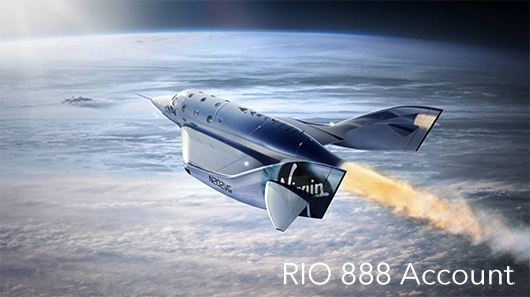
VIRGIN GALACTIC COMPLETES 12TH SUCCESSFUL SPACEFLIGHTVirgin Galactic just launched its seventth commercial spaceflight. ORANGE COUNTY, Calif. – (June XX, 2024) – Virgin Galactic Holdings, Inc. (NYSE: SPCE) (“Virgin Galactic” or the “Company”) today announced the completion of its second spaceflight of 2024 and 12th mission to date, carrying one researcher and three private astronauts. Today’s ‘Galactic 07’ flight marks the Company’s seventh research mission with Virgin Galactic’s spaceship again serving as a suborbital lab for space-based scientific research. Onboard ‘Galactic 07’: ● Astronaut 027 – Tuva Cihangir Atasever, Turkish Space Agency (TUA) astronaut and Axiom Mission 3 (Ax-3) Backup Mission Specialist ● Astronaut 028 – Anand “Andy” Harish Sadhwani, California, USA ● Astronaut 029 – Irving Izchak Pergament, New York, USA ● Astronaut 030 – Giorgio Manenti, Italy ‘Galactic 07’ ’Flight Facts ● Take-off Time: 08:31 am MT ● Altitude at Release: 44,562 ft ● Apogee: 54.4 miles ● Top Speed: Mach 2.96 ● Landing Time: 9:41 am MT “Watching our pioneering spaceship Unity return from space on its final commercial flight was a breathtaking and proud moment as we celebrate the ship’s unprecedented achievements in human spaceflight and build momentum for the rollout of our first Delta Class ships in 2026,” said Michael Colglazier, CEO of Virgin Galactic. On today’s flight, Atasever flew with three human-tended experiments, including custom headgear with brain activity monitoring sensors to collect physiological data related to human spaceflight; a dosimeter; and two commercially available insulin pens to examine the ability to administer accurate insulin doses in microgravity. He also participated in four investigations carried out by Turkish researchers on the ground to understand physiological changes during suborbital spaceflight. “I am beyond grateful to have represented my country on ‘Galactic 07’ and conduct groundbreaking research that will impact future space missions,” said Atasever. “The successful completion of Ax-3 and now ‘Galactic 07’ is just the beginning of Türkiye’s space endeavors. May our people at home continue to be inspired and dream beyond the stars.” ‘Galactic 07’ also flew two autonomous rack-mounted payloads supported by NASA’s Flight Opportunities program: a Purdue University experiment to study propellant slosh for spacecraft propulsion applications and a University of California, Berkeley experiment to test new 3D printing technology while in microgravity. The flight was Virgin Galactic’s seventh spaceflight carrying microgravity and space-based research, following last year’s research missions, ‘Galactic 05’ with U.S. Planetary Scientist Dr. Alan Stern and U.S. Payload Specialist and Bioastronautics Researcher Kellie Gerardi, and ‘Galactic 01’ with the Italian Air Force and National Research Council. VSS Unity was piloted by Commander Nicola Pecile and Pilot Jameel Janjua. VMS Eve was piloted by Commander Andy Edgell and Pilot C.J. Sturckow. |